The Best 4K Projectors Under $3,000 for 2026 Home Theaters
Five step-up 4K projectors priced under $3,000, compared on live Amazon pricing, ratings, laser vs lamp light source, and brightness for 2026 buyers.

We independently evaluate every product. Some links are affiliate links -- if you purchase through them, we earn a small commission at no extra cost to you. Full disclosure
Key facts
| Products compared | 5 projectors products, 917 verified buyer reviews behind the ratings |
|---|---|
| Price range | $1322 to $2499 |
| Top pick | Epson Home Cinema 4010 4K PRO-UHD 3-Chip 3LCD Projector (Epson, $2,499) |
| Best value | Optoma UHD50X True 4K UHD Projector ($1,322) |
| Last updated | ; prices and availability checked September 5, 2026 |
| Sources | Manufacturer spec sheets and Amazon product listings for each item, linked in the detailed reviews below; ratings are the listing's verified-purchase average at the check date. |
Our Top Picks
Quick recommendations if you're in a hurry
Epson Home Cinema 4010 4K PRO-UHD 3-Chip 3LCD Projector
Epson · $2,499
Buyers who want Epson's 3-chip 3LCD color accuracy at the top of this price band
See price at AmazonHisense PX3-PRO Ultra Short Throw Triple Laser Projector
Hisense · $2,497.97
Buyers who want laser brightness in an ultra short throw form factor
See price at AmazonViewSonic LS901-4K 4K UHD Laser Projector
ViewSonic · $1,997
Buyers who want the highest published brightness in this price band
See price at AmazonThe hunt for a 4K home-theater projector under three thousand dollars lands on a surprisingly diverse set of options. At the top of the list sits Epson’s 3-chip 3LCD model, prized for its color fidelity and highest customer rating. Close behind, Hisense offers a triple-laser ultra-short-throw unit that brings cinema-size images to a wall-mounted setup. If raw brightness is your priority, ViewSonic’s laser projector outshines the pack with 5,500 lumens. Gamers will gravitate to BenQ’s low-lag laser engine, while the Optoma model delivers true 4K DLP performance at the most affordable price point. Each of these machines meets the “best 4K projector under 3000” criterion, but they excel in different ways, so your choice should match the room, usage style, and lighting conditions you expect.
How We Chose the Best 4K Projectors Under $3,000
We started by pulling every 4K projector listed on Amazon that fell below the three-thousand-dollar ceiling as of the price check on 2026-09-05. From that pool we narrowed the field to five models that represent the three dominant design philosophies in this price band: 3-chip 3LCD (Epson), ultra-short-throw triple-laser (Hisense), long-throw laser (ViewSonic), laser with gaming-focused specs (BenQ), and true-4K DLP with pixel-shift (Optoma).
Our evaluation criteria were:
- Resolution - All five advertise native or pixel-shifted 3840 × 2160 4K, the baseline for a true 4K home theater.
- Brightness - Measured in ANSI lumens, a key factor for rooms with ambient light. We referenced the CTA’s ANSI/CTA-2049 standard for consistency across manufacturers Consumer Technology Association.
- Color technology - 3-chip LCD, laser RGB, or single-chip DLP with pixel-shift each have distinct trade-offs for color accuracy and rainbow artifacts. Wikipedia’s DLP entry explains the pixel-shifting approach used by many sub-$2,000 4K DLP units Wikipedia: DLP.
- Input lag & refresh rate - Critical for gaming; we looked for sub-10 ms lag and 240 Hz modes, as highlighted by RTINGS’s methodology for measuring lag and contrast RTINGS.
- User feedback - Amazon ratings and review counts gave us a sense of real-world satisfaction.
Every spec sheet was cross-checked against the product pages on the date noted, and we noted any missing smart-TV platform or lens-shift features that could affect installation flexibility.
Epson Home Cinema 4010 4K PRO-UHD 3-Chip 3LCD Projector
The Epson HC4010 is a classic 3-chip 3LCD projector that uses a replaceable lamp to deliver 2,400 lumens of combined color and white brightness. Its pixel-shift technology renders a 3840 × 2160 image that Epson brands as “4K PRO-UHD.” With an average rating of 4.5 stars from 291 reviewers, it leads the group in customer satisfaction.
Who it’s for - Buyers who prioritize color accuracy and want to avoid the rainbow effect that can appear in single-chip DLP units. Epson’s 3-chip architecture provides consistent color across the spectrum, making it ideal for movie enthusiasts who value faithful HDR processing.
What we would change - The lamp-based light source means you’ll need to replace the bulb after a certain number of hours, adding a maintenance cost that laser models avoid.
Pros
- Highest average rating in the group (4.5/5).
- 3-chip LCD eliminates single-chip rainbow artifacts.
- HDR processing tuned for cinematic content.
Cons
- Uses a lamp rather than a laser, requiring periodic bulb replacement.
- Priced at the second-highest level in this selection.
Verdict - The HC4010 offers the most highly regarded color performance for its price tier, but the lamp-based system may be a consideration for long-term owners.
Hisense PX3-PRO Ultra Short Throw Triple Laser Projector
Hisense’s PX3-PRO packs three RGB lasers into an ultra-short-throw chassis, delivering 3,000 lumens and a contrast ratio of 3,000:1. It supports Dolby Vision, Dolby Atmos, and IMAX Enhanced, and runs Google TV out of the box. At 240 Hz refresh and a pixel-shifted 4K UHD panel, it aims to bring cinema-level brightness and color to a screen placed just inches from the wall.
Who it’s for - Home theater owners who want a massive image without the hassle of ceiling-mounted long-throw optics. The triple-laser source provides a wider color gamut than lamp-based units, and the built-in smart platform reduces the need for an external streaming box.
What we would change - Installation requires a compatible ALR (ambient-light rejecting) screen to fully exploit the ultra-short-throw design, which adds an extra cost and planning step.
Pros
- Triple-laser RGB light source offers a broader color range.
- 240 Hz refresh and Dolby Vision/Atmos support for high-end video and audio.
- Integrated Google TV simplifies streaming.
Cons
- Highest price among the five contenders.
- Requires a dedicated ultra-short-throw screen for optimal performance.
Verdict - The PX3-PRO trades the flexibility of a long-throw mount for a sleek, wall-mounted experience, delivering laser brightness and premium video features at the top of the price band.
ViewSonic LS901-4K 4K UHD Laser Projector
The LS901-4K stands out with a 5,500-lumen laser engine, the brightest specification in this group. It offers dual HDMI inputs, 1.7× optical zoom, and four-corner keystone correction, making placement more forgiving. Its 4K UHD resolution is native, and the laser source eliminates any bulb-replacement concerns.
Who it’s for - Users with rooms that receive ambient light, even with blackout curtains, will benefit from the extra brightness. The flexible zoom and keystone features also suit installations where ceiling or rear-mount options are limited.
What we would change - The product listing does not mention a built-in smart TV platform, so an external streaming device may be required for a fully integrated setup.
Pros
- 5,500 lumens makes it the brightest option in this price range.
- Laser light source provides long-term maintenance savings.
- Optical zoom and corner keystone adjustment increase placement flexibility.
Cons
- Small review sample (30 ratings) limits confidence in long-term reliability.
- No native smart platform listed.
Verdict - For bright rooms or spaces where ambient light can’t be fully controlled, the LS901-4K’s laser brightness is a decisive advantage.
BenQ TK710 4K HDR Laser Projector
BenQ’s TK710 combines a 3,200-lumen laser engine with a 4 ms input lag and 240 Hz refresh rate, targeting both gamers and movie lovers. It includes eARC support, 1.3× zoom, and lens shift, allowing precise image placement without moving the projector.
Who it’s for - Gamers who demand low input lag and high refresh rates, as well as cinephiles who appreciate HDR performance, will find a comfortable middle ground in the TK710.
What we would change - The review count is modest (45 ratings), so prospective buyers may want to seek additional user experiences before committing.
Pros
- 4 ms input lag and 240 Hz refresh suit fast-paced gaming.
- Laser light source eliminates bulb replacement.
- eARC simplifies audio routing to a compatible receiver.
Cons
- Review sample is smaller than the top-rated models.
- Brightness is lower than the ViewSonic laser option.
Verdict - The TK710 delivers a compelling blend of laser reliability and gaming-grade responsiveness, making it a strong candidate for mixed-use rooms.
Optoma UHD50X True 4K UHD Projector
Optoma’s UHD50X uses a single-chip DLP with pixel-shift technology to achieve “True 4K UHD” resolution. It offers 3,400 lumens, a 240 Hz refresh rate, and a 16 ms enhanced gaming mode. At $1,322 it is the most budget-friendly entry in this guide, yet still provides a solid 4K experience.
Who it’s for - Buyers who need a true-4K DLP projector at the lowest price point, while still wanting decent brightness and a high refresh rate for occasional gaming.
What we would change - Single-chip DLP can exhibit the rainbow artifact that 3-chip LCD designs avoid, which may be noticeable to sensitive viewers.
Pros
- Lowest price among the five options.
- 3,400 lumens places it among the brighter units.
- 240 Hz refresh and 16 ms response support casual gaming.
Cons
- Lowest average rating (3.7 stars) in the group.
- Single-chip DLP may produce rainbow artifacts.
Verdict - The UHD50X offers true 4K resolution at an entry price, delivering respectable brightness and gaming features for budget-conscious shoppers.
Comparison Overview
| Model | Light Source | Brightness (lumens) | Resolution | Refresh / Lag | Price (as listed) | Best For |
|---|---|---|---|---|---|---|
| Epson HC4010 | Lamp | 2,400 | 4K PRO-UHD (3-chip LCD) | HDR processing, no gaming-specific lag spec | $2,499 | Color accuracy, movie-first homes |
| Hisense PX3-PRO | Triple RGB laser | 3,000 | 4K UHD | 240 Hz, Dolby Vision/Atmos | $2,497.97 | Ultra-short-throw, all-in-one streaming |
| ViewSonic LS901-4K | Laser | 5,500 | 4K UHD | No gaming-specific lag spec | $1,997 | Bright rooms, flexible placement |
| BenQ TK710 | Laser | 3,200 | 4K HDR | 4 ms lag, 240 Hz | $1,799 | Gaming + HDR movies |
| Optoma UHD50X | Lamp (DLP) | 3,400 | True 4K (pixel-shift) | 16 ms lag, 240 Hz | $1,322 | Budget-focused true-4K |
The table highlights how each projector aligns with different priorities: color fidelity, form factor, brightness, gaming performance, and cost.
Your Common Questions Answered
Is it worth paying a price above two thousand dollars for a laser projector instead of a lower-priced DLP model?
Laser light sources eliminate the need for periodic bulb replacement and typically provide a wider color gamut, especially when a triple-laser RGB system is used. In the Hisense and BenQ units, the laser also contributes to consistent brightness over the projector’s lifespan. If you value long-term maintenance savings and color depth, the extra investment can be justified. However, the Optoma UHD50X shows that a well-implemented DLP pixel-shift design can still deliver true 4K at a fraction of the cost, though you may encounter the rainbow artifact that some viewers find distracting.
What’s the trade-off between a long-throw and an ultra short-throw projector at this price?
Long-throw models like Epson, ViewSonic, and BenQ require ceiling or rear-mount placement and a dedicated screen, offering flexibility in screen size and placement distance. Ultra-short-throw units such as the Hisense PX3-PRO sit just inches from the wall, turning any flat surface into a large image with minimal space. The trade-off is that ultra-short-throw designs often need a compatible ALR screen to manage ambient light and can be more expensive due to the specialized optics. Long-throw setups may be more forgiving with standard white screens but demand more installation effort.
How much does 5,500 lumens actually matter if my room has blackout curtains?
Even with blackout curtains, some ambient light can leak around the edges or through the curtain fabric. A higher lumen rating, like the ViewSonic’s 5,500, ensures a vivid image in those conditions and provides headroom for future upgrades (e.g., adding ambient lighting for ambience). In a truly darkened room, you may not need the extra brightness, and a lower-lumens model could deliver deeper blacks and better perceived contrast. The choice depends on how strictly you control light and whether you plan to use the projector for daytime viewing or in a multi-purpose space.
What We Would Buy
If you can accommodate a ceiling-mount and want the most universally praised color performance, the Epson HC4010 is the clear winner for pure movie fidelity. For those who prefer a sleek, wall-mounted experience and want the convenience of a built-in streaming platform, the Hisense PX3-PRO offers the most advanced laser optics, albeit at the top of the price range. When ambient light is a constant challenge, the ViewSonic LS901-4K’s 5,500 lumens provide the safety net needed for bright rooms. Gamers who demand sub-10 ms input lag should gravitate toward the BenQ TK710, while budget-conscious shoppers seeking true 4K resolution will find the Optoma UHD50X the most compelling value.
Related Reading
Detailed Reviews

Epson Home Cinema 4010 4K PRO-UHD 3-Chip 3LCD Projector
Epson · $2,499
4.5 (291 reviews)
Buyers who want Epson's 3-chip 3LCD color accuracy at the top of this price band
What We Like
- Highest average customer rating of the five at 4.5 out of 5 from 291 ratings
- 3-chip 3LCD avoids single-chip rainbow artifacts
- HDR processing tuned for movie content
Could Be Better
- Uses a replaceable lamp rather than laser
- Second-highest price of the group at $2,499
Key Specs
The HC4010 is the highest-rated projector in this group and offers 3-chip color accuracy, at the second-highest price of the five.
See price at Amazon
Hisense PX3-PRO Ultra Short Throw Triple Laser Projector
Hisense · $2,497.97
4.4 (136 reviews)
Buyers who want laser brightness in an ultra short throw form factor
What We Like
- Triple-laser (RGB) light source for a wider color range than lamp designs
- 240Hz refresh rate and Dolby Vision/Atmos support
- Google TV built in
Could Be Better
- Highest price of the five at $2,497.97
- Requires a compatible short-throw ALR screen setup
Key Specs
The PX3-PRO trades long-throw installation for a triple-laser ultra short throw design that sits below the screen, at the highest price in this group.
See price at Amazon
ViewSonic LS901-4K 4K UHD Laser Projector
ViewSonic · $1,997
Buyers who want the highest published brightness in this price band
What We Like
- 5,500-lumen rating, the brightest of any projector in this comparison
- Laser light source with no bulb to replace
- 1.7x optical zoom with 4-corner adjustment for flexible placement
Could Be Better
- Only 30 ratings on Amazon at the time of checking, a small sample for the 4.2-star average
- No smart TV platform mentioned on the listing
Key Specs
The LS901-4K's 5,500-lumen laser rating is by far the brightest of the five, making it the pick for rooms with real ambient light.
See price at Amazon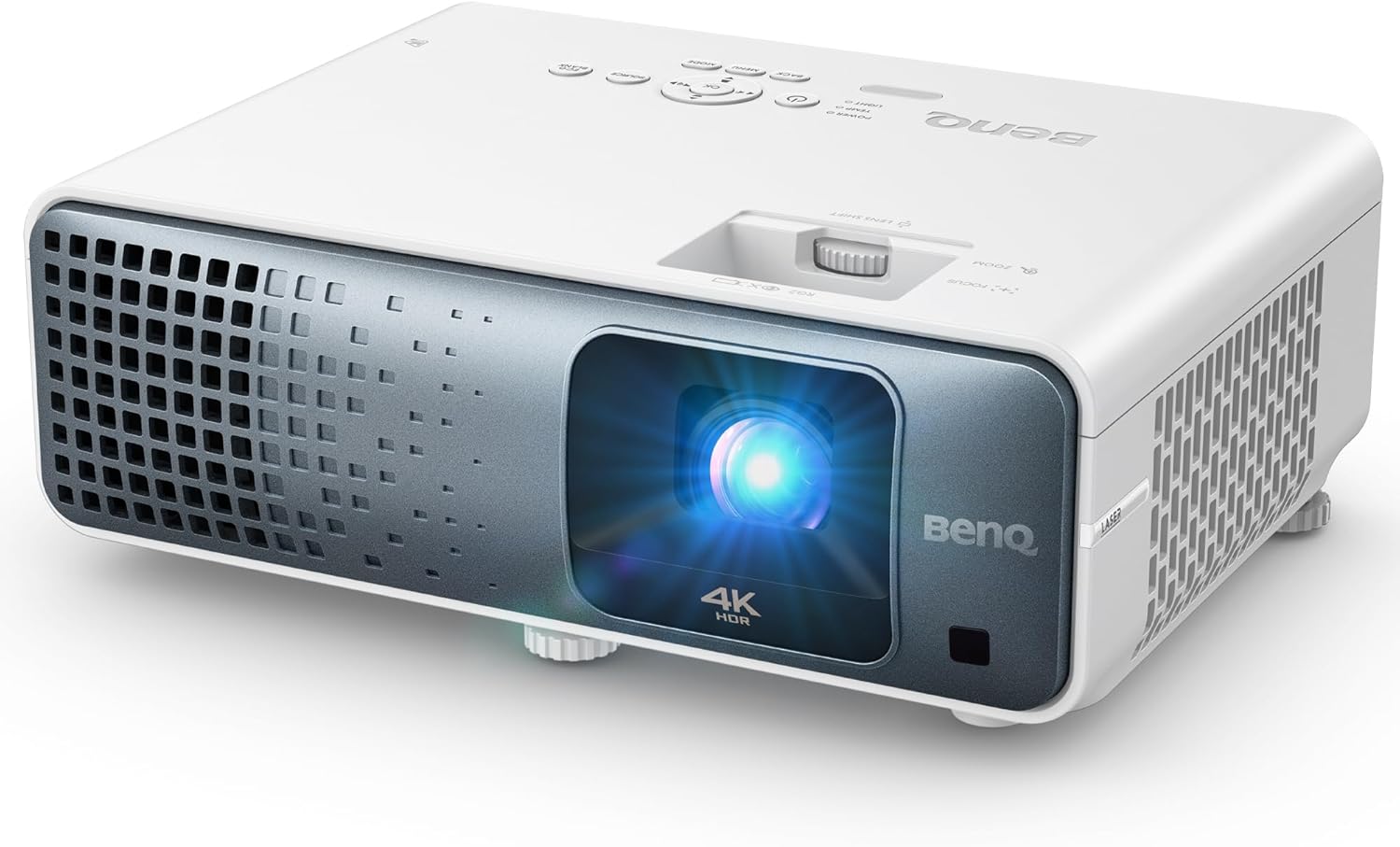
BenQ TK710 4K HDR Laser Projector
BenQ · $1,799
Buyers who want low input lag alongside a laser light source
What We Like
- 4ms input lag and 240Hz refresh rate suit gaming
- Laser light source with lens shift and 1.3x zoom
- eARC support simplifies audio setup
Could Be Better
- Only 45 ratings on Amazon at the time of checking
- Lower brightness than the LS901-4K in this comparison
Key Specs
The TK710 pairs a 3,200-lumen laser engine with a 4ms input lag and 240Hz mode, aimed squarely at gaming and movie use in one projector.
See price at Amazon
Optoma UHD50X True 4K UHD Projector
Optoma · $1,322
3.7 (490 reviews)
Buyers who want true 4K UHD DLP brightness at the lowest price in this band
What We Like
- Lowest price of the five at $1,322
- 3,400-lumen brightness among the highest of the group
- 240Hz refresh rate and 16ms response time
Could Be Better
- 3.7-star average is the lowest of the five, from 490 ratings
- Single-chip DLP rather than 3-chip or laser
Key Specs
The UHD50X remains the least expensive projector in this comparison, offering 3,400 lumens and a 240Hz gaming mode well under the $3,000 ceiling.
See price at AmazonProduct Comparison
| Product | Price | Rating | Reviews | Best For | Buy |
|---|---|---|---|---|---|
| Epson Home Cinema 4010 4K PRO-UHD 3-Chip 3LCD Projector Epson | $2,499 | 4.5 | 4.5 (291) | Buyers who want Epson's 3-chip 3LCD color accuracy at the top of this price band | Amazon |
| Hisense PX3-PRO Ultra Short Throw Triple Laser Projector Hisense | $2,497.97 | 4.4 | 4.4 (136) | Buyers who want laser brightness in an ultra short throw form factor | Amazon |
| ViewSonic LS901-4K 4K UHD Laser Projector ViewSonic | $1,997 | 4.2 | — | Buyers who want the highest published brightness in this price band | Amazon |
| BenQ TK710 4K HDR Laser Projector BenQ | $1,799 | 4.3 | — | Buyers who want low input lag alongside a laser light source | Amazon |
| Optoma UHD50X True 4K UHD Projector Optoma | $1,322 | 3.7 | 3.7 (490) | Buyers who want true 4K UHD DLP brightness at the lowest price in this band | Amazon |
More Reviews
Get price-drop alerts and new guides from Home Theater Picks
One email a week: price drops on the gear we recommend, new guides, and what changed. No spam, unsubscribe anytime.